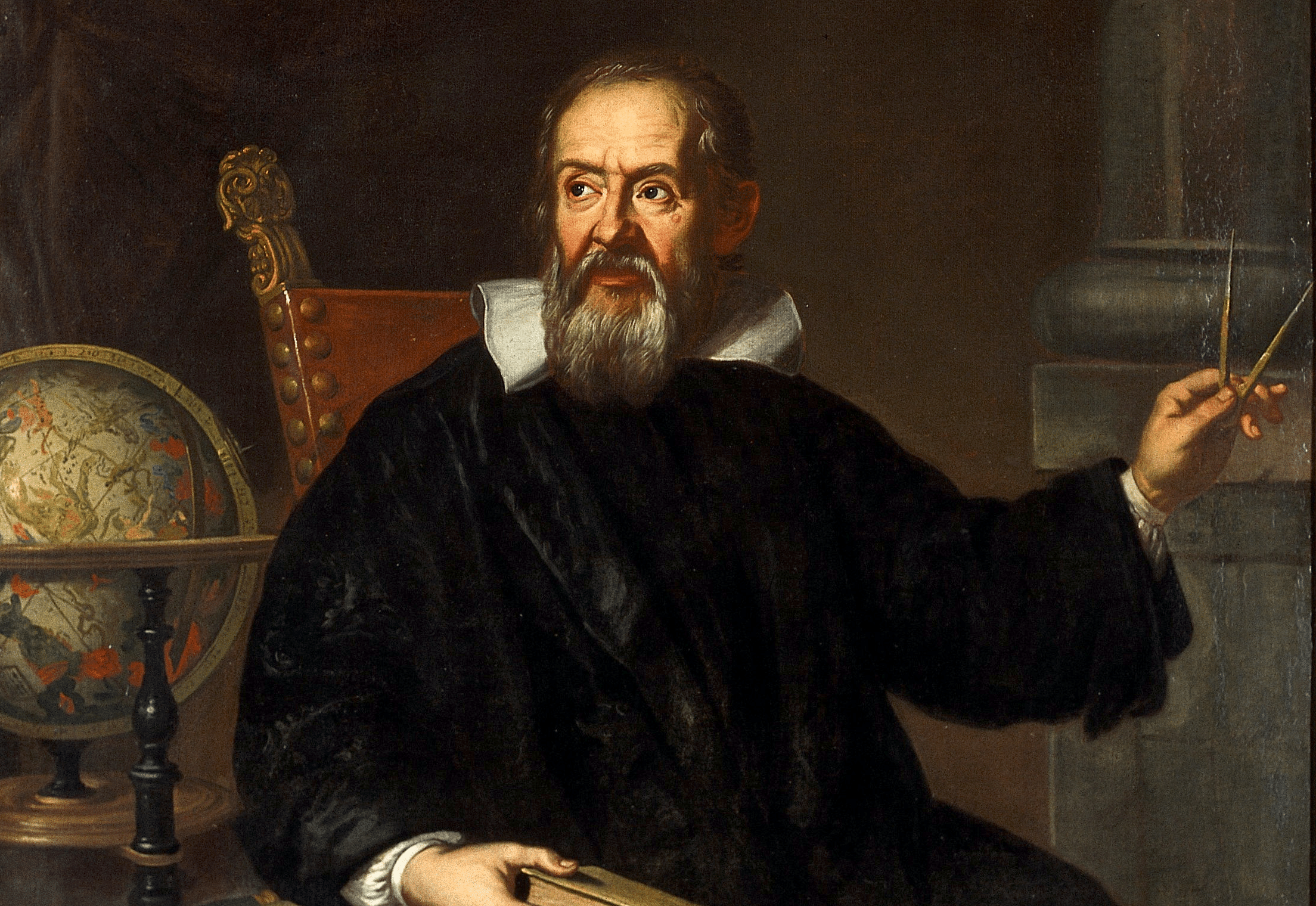
In this episode, student historians Nico Mosquera and Ranger Fair tackle a persistent myth about the trial of Galileo Galilei: that he was tortured by authorities within the Catholic Church for challenging prevailing religious beliefs. Studying the transcripts of the trial, as well as Galileo’s own writings, these historians tell the real story of Galileo’s beliefs about science and religion and his resulting his trial by the Roman Inquisition.
Sources Cited in this Episode
Finocchiaro, Maurice A., ed. “Galileo’s Letter to the Grand Duchess Christina (1615).” In The Galileo Affair: A Documentary History, 87–118. Berkeley: University of California Press, 1989. http://www.jstor.org/stable/10.1525/j.ctt1ppb13.7.
Finocchiaro, Maurice A., ed. “The Later Inquisition Proceedings (1633).” In The Galileo Affair: A Documentary History, 256–94. Berkeley: University of California Press, 1989. http://www.jstor.org/stable/10.1525/j.ctt1ppb13.13.
Jacob, M. C. The Scientific Revolution: A Brief History with documents. New York: Bedford/St. Martin’s, 2019.
McMullin, Ernan. The Church and Galileo. Notre Dame, Ind: University of Notre Dame Press, 2005.
Numbers, Ronald L. Galileo Goes to Jail : And Other Myths about Science and Religion. Cambridge, Mass: Harvard University Press, 2009.
Segre, Michael. “Light on the Galileo Case?” Isis 88, no. 3 (1997): 484–504. http://www.jstor.org/stable/236153.
Westfall, Richard S. Essays on the Trial of Galileo. Vatican City State: Vatican Observatory, 1989.
Further Reading
Fantoli, Annibale. 2003. Galileo, for Copernicanism and for the Church. 3rd ed., rev.corr. Vatican City: Vatican Observatory Publications.
Mayer, Thomas F. (Thomas Frederick), and JSTOR Ebooks. The Roman Inquisition : Trying Galileo. Philadelphia: University of Pennsylvania Press, 2015.
Meet Our Guest
Dr. Erik Estrada is an Assistant Professor in the department of Religion at Texas Christian University. He is a church historian and historical theologian with a focus on the history of biblical interpretation, spanning from the early Church to the modern era. He is currently working on a project that examines the history of Pauline interpretation from Late Antiquity to the present day.

Nico Mosquera
Nico is a junior Communication Studies major with a minor in Business from Danville, California.
Ranger Fair
Ranger is a Communication Studies major with a Computer Science minor from Boulder, Colorado, graduating in December 2025.