Join host Gavin McGuffin for a discussion of conscription policy in post-war America, the origins of the 1969 lottery draft, and how the draft affected college campuses during the Vietnam War.

Gavin McGuffin
Gavin is a senior Political Science major and History minor. Upon graduation, he plans to attend law school.
Sources
Creedence Clearwater Revival, “Fortunate Son,” Fantasy Studios, 1969.
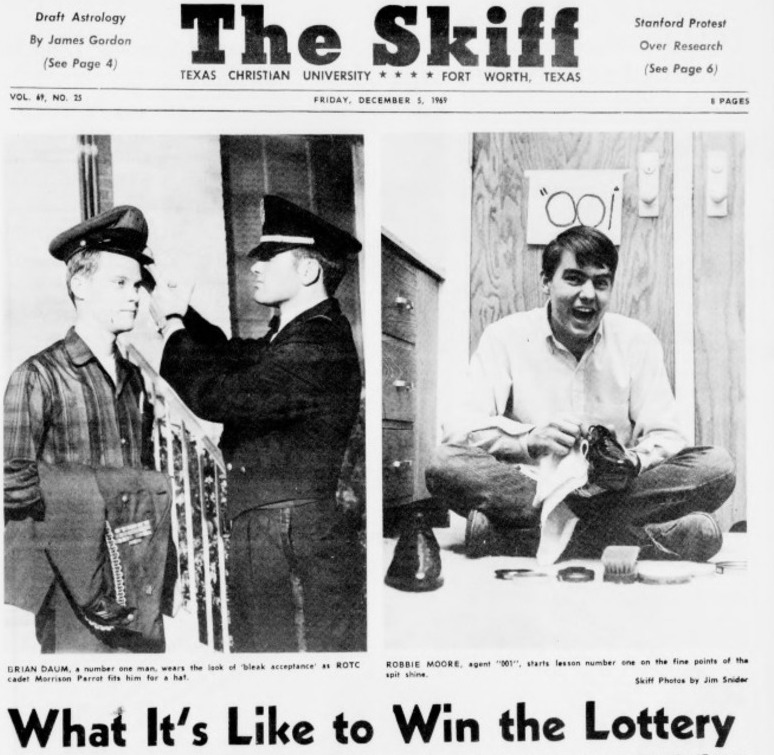
Farrell, Shirley. “What It’s Like to Win the Lottery.” December 5, 1969.
Johnson, Lyndon B. “State of the Union Address.” January 14, 1969. Available at Historyonthenet.com. Accessed December 4, 2023.
“VIPs in History Get the Draft Shaft Too!” The Skiff. December 9, 1969.
For Further Reading
Brewer, Susan A. Why America Fights : Patriotism and War Propaganda from the Philippines to Iraq. Cary: Oxford University Press, 2009.
Rutenberg, Amy J. Rough Draft: Cold War Military Manpower Policy and the Origins of Vietnam-Era Draft Resistance. New York: Cornell University Press, 2019.
Wright, James Edward. Enduring Vietnam: An American Generation and its War. New York: Thomas Dunne Books, St. Martin’s Press, 2017
Meet the Expert
Dr. Amy Rutenberg is an associate professor of history at Iowa State University. Dr. Rutenberg’s research primarily focuses on the relationships among military service, race, and American society in the post World War II era. Her first book, Rough Draft, explores how policy makers’ assumptions about race, and class during the Cold War led the draft system to target working-class and minority men for conscription while middle-class, white men were targeted for deferments in the years leading up to the Vietnam War. Dr. Rutenberg’s work has appeared in a number of notable publications, including the The New York Times, and The Atlantic.