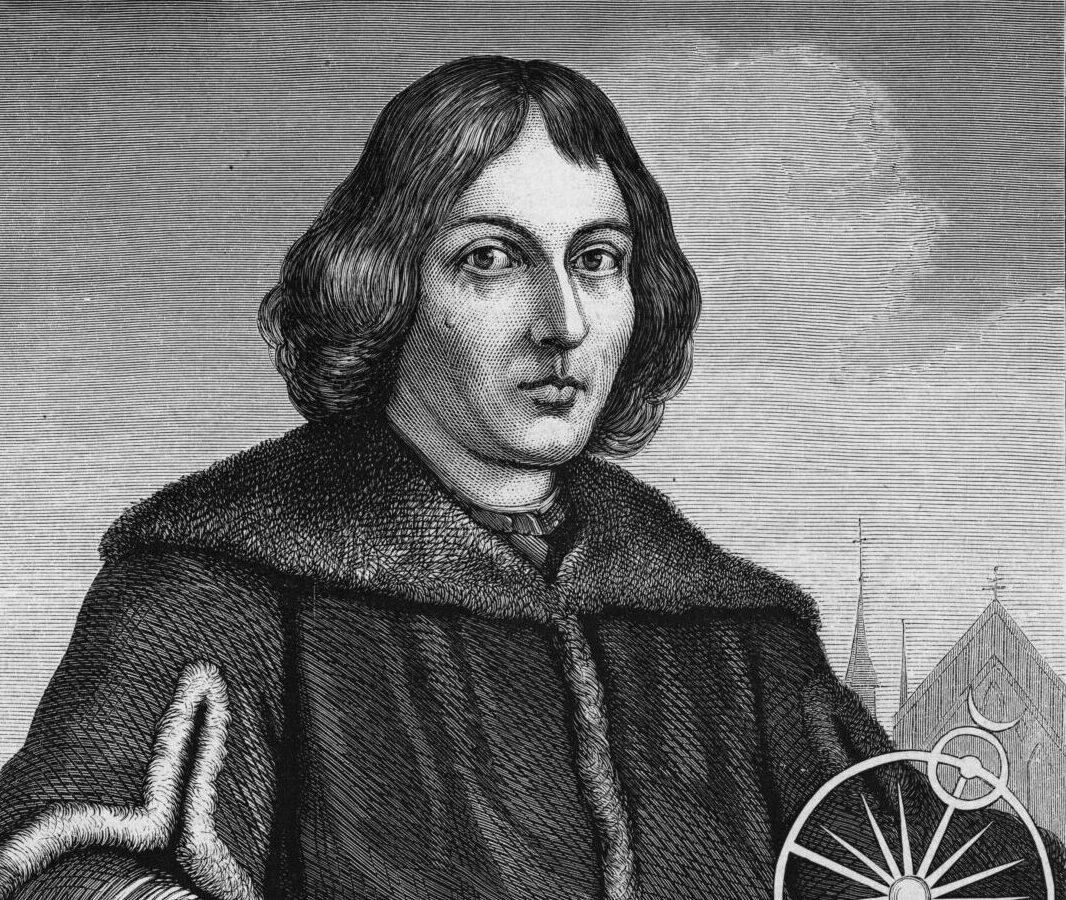
In this episode, student historians Viktor Lord Harrington, Lauren Flores, and Samuel Saenz tackle a myth propagated by the twentieth-century psychologist Sigmund Freud. Freud argued in an early twentieth-century lecture that the early modern revolution in astronomy which placed the sun, rather than the earth, at the center of the universe, had a profound effect on our collective human psyche. So did Copernicus demote humanity?
Sources Cited in this Episode
Grendler, Paul F. “The Universities of the Renaissance and Reformation.” Renaissance Quarterly 57, no. 1 (Spring 2004): 1-42.
Lombardo, Nicholas. “Chapter 3: The Controversy: Bonaventure and Aristotle.” In Aristotle and the Ontology of St. Bonaventure, 73-94. Leuven: Leuven University Press, 2023.
Elizabeth Lowe, “The Contested Theological Authority of Thomas Aquinas: The Controversies Between Hervaeus Natalis and Durandus of St. Pourçain, 1307-1323,” Renaissance Quarterly 57, no. 1 (Spring 2004): 1-42.
Nicolaus Copernicus. De Revolutionibus Orbium Cœlestium, Libri VI. Nuremberg, 1543. Translated by Edward Rosen. Warsaw: Polish Scientific Publications, 1978
Thomas Aquinas, De Caelo et Mundo, accessed March 14, 2025
Freud, Sigmund. Introductory Lectures on Psycho-analysis: A Course of Twenty-Eight Lectures Delivered at the University of Vienna. United Kingdom: G. Allen & Unwin, 1922.
Freud, Sigmund. An Autobiographical Study. Mansfield Centre, CT: Martino Publishing, 2010.
Further Reading
Aquinas, Thomas. De caelo (On the Heavens). Translated by Fabian R. Larcher and Pierre H. Conway, Book II, Lecture 12.
Copernicus, Nicolaus. De revolutionibus orbium coelestium, Libri VI. Nuremberg, 1543. Translated by Owen Gingerich, Warsaw: Polish Scientific Publications, 1978.
Freud, Sigmund. Introductory Lectures on Psycho-Analysis: A Course of Twenty-Eight Lectures Delivered at the University of Vienna. Translated by Joan Riviere, London: Georges Allen and Unwin, 1922.
Meet Our Guest
Dr. Jessica Stephens is a Lecturer of Psychology at TCU who received her M.S. degree and Ph.D. emphasizing Experimental Psychology from the University of Texas at Arlington in 2022. She earned her primary B.S. degree with the highest honors from Texas A&M University at Kingsville in 2011, and her primary M.S. degree emphasizing Licensed Professional Counseling from Texas A&M University at Kingsville in 2013. Dr. Stephens received an award for teaching effectiveness at Texas A&M University in Kingsville. Additionally, Dr. Stephens has served as the dual-enrollment program coordinator (2016-2017) and undergraduate psychology program coordinator (2015) for the psychology department at Texas A&M University at Kingsville. Dr. Stephens has also served as an honorary speaker for events on drug awareness and suicide prevention.
Audio Citations
Music_For_Videos. “Warm Piano Logo.” Pixabay, https://pixabay.com/sound-effects/warm-piano-logo-116098/.
Ni Sound. “Timeless Logos – Bright Angelic Synth Pad Hit, Fade Out.” Artlist, https://artlist.io/sfx/track/timeless-logos—bright-angelic-synth-pad-hit-fade-out/83657.
Ni Sound. “Timeless Logos – Vibrato Synth Organ Chord, Fade Out.” Artlist, https://artlist.io/sfx/track/timeless-logos—vibrato-synth-organ-chord-fade-out/83663.
Setuniman. “Pensive Atmosphere 0_20d.” Freesound, https://freesound.org/people/Setuniman/sounds/135669/.

Viktor Lord Harrington
Viktor is a junior from Fort Worth, Texas, majoring in Marketing.

Lauren Flores
Lauren is a recent alumna of TCU from Aledo, Texas, with a degree in Combined Science and a minor in Psychology.

Samuel Saenz
Samuel is a senior from San Antonio, Texas, majoring in Economics with a minor in Political Science.