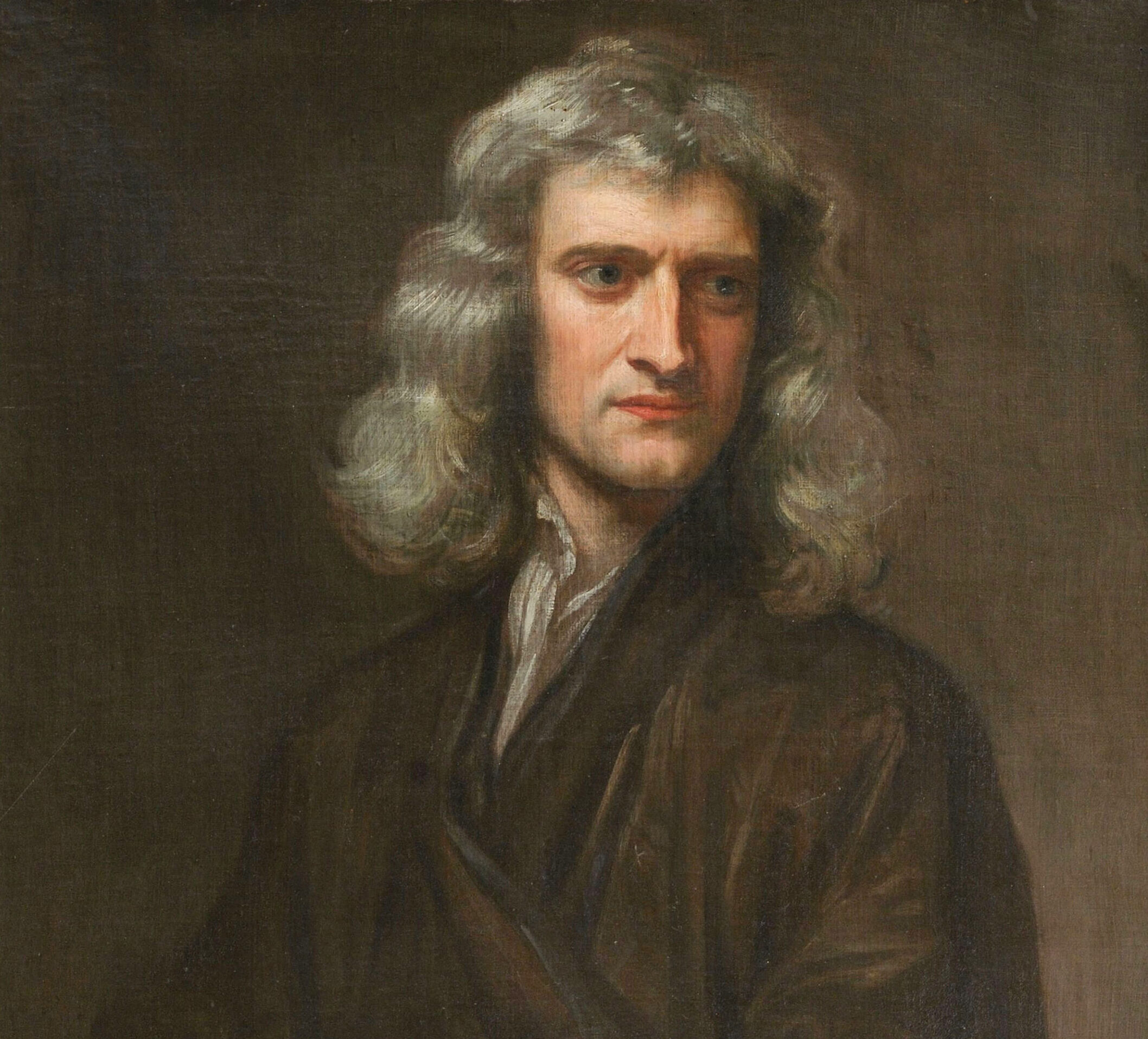
Perhaps no one encapsulates the incredible advancements of the so-called Scientific Revolution like the English polymath Isaac Newton. Newton is credited with discovering gravity, advancing our understanding of the properties of light, and inventing calculus. In this episode, student historians Marin Newman and Cuatro Welder tackle the myth that when Newton proposed that mathematical laws governed the universe, he was directly challenging those who believed in a universe created by God.
Sources cited in this Episode
Daston, Lorraine. “The Nature of Nature in Early Modern Europe.” Configurations 6, no. 2 (1998): 149–172.
Leibniz, G. W., and Samuel Clarke. Exchange of Papers between Leibniz and Clarke. Edited by Jonathan Bennett. 2017. https://www.earlymoderntexts.com/assets/pdfs/leibniz1715_1.pdf.
Newton, Isaac. An Account of the Systeme of the World. MS Add. 4005.7, ff. 39-42. Cambridge University Library, Cambridge, UK. Published online March 2010. Accessed March 14, 2025. Newton Project.
Newton, Isaac. “Letter to Richard Bentley, 10 December 1692.” Original manuscript, Trinity College Library, Cambridge, UK. Published online October 2007. The Newton Project. https://www.newtonproject.ox.ac.uk/view/texts/normalized/THEM00254.
Newton, Isaac. Two Notable Corruptions of Scripture (Part 1: ff. 1-41). Original manuscript, New College Library, Oxford, UK. Published online January 2008. The Newton Project. https://www.newtonproject.ox.ac.uk/view/texts/normalized/THEM00261.
Newton, Isaac. The Principia: Mathematical Principles of Natural Philosophy. Translated by I. Bernard Cohen and Anne Whitman, assisted by Julia Budenz. Berkeley: University of California Press, 1999.
Snobelen, Stephen D. “Isaac Newton, Heretic: The Strategies of a Nicodemite.” The British Journal for the History of Science 32, no. 4 (1999): 381–419.
Westfall, Richard S. “Newtonianism and the Enthusiasm of Enlightenment.” Studies in Eighteenth-Century Culture 3 (1973): 81–91.
Audio Sources
Gervais, Ricky. “Ricky Gervais and Stephen Go Head-to-Head on Religion.” Interview by Stephen Colbert. The Late Show with Stephen Colbert. YouTube video, 8:12. Posted February 1, 2017. https://www.youtube.com/watch?v=QZLv3Z7L5lY.
Tyson, Neil deGrasse. “Neil deGrasse Tyson on Religion and Science.” Interview by Big Think. YouTube video, 5:58. Posted June 30, 2015. https://www.youtube.com/watch?v=Yz49TnHeVmQ.
Natural Readers. “Online Text to Speech Free Voice Generator.” Accessed April 27, 2025. https://www.naturalreaders.com/online/.
Further Reading
Bentley, Richard. Eight Sermons Preach’d at the Honourable Robert Boyle’s Lecture, in the First Year, MDCXCII. Grand Rapids: Christian Classics Ethereal Library. https://www.ccel.org/ccel/b/bentley/sermons/cache/sermons.pdf.
Force, James E. “Newton’s God of Dominion: The Unity of Newton’s Theological, Scientific, and Political Thought.” In Essays on the Context, Nature, and Influence of Isaac Newton’s Theology, edited by James E. Force and Richard H. Popkin, 75–95. Dordrecht: Kluwer Academic Publishers, 1990.
Gore-Booth, Eva. The Inner Life of the Child. London: Longmans, Green and Co., 1916.
Iliffe, Rob. Priest of Nature: The Religious Worlds of Isaac Newton. Oxford: Oxford University Press, 2017.
Janiak, Andrew. Newton. Malden, MA: Blackwell Publishing, 2015.
Janiak, Andrew, and Eric Schliesser, eds. Interpreting Newton: Critical Essays. Cambridge: Cambridge University Press, 2012.
Locke, John. An Essay Concerning Humane Understanding. London: Printed by Eliz. Holt, for Thomas Basset, at the George in Fleet Street, near St. Dunstan’s Church, 1690. https://www.gutenberg.org/files/10615/10615-h/10615-h.htm
Meet our Special Guest
Dr. Patricia Duncan is an Associate Professor of Religion at Texas Christian University. She holds a Ph.D. and M.Div. from the University of Chicago, and a B.A. from the University of Missouri–Columbia. She is affiliated with the AddRan College of Liberal Arts and teaches courses on Paul and the Early Church, Women and Early Christianity, Ancient Greek, and others. Dr. Duncan’s primary research interests are the New Testament and early Christian thought within a broader landscape. Her work also centers on how religious texts were read, interpreted, and sometimes resisted in the ancient world. Dr. Duncan’s refereed publications include “Eve, Mattidia, and the Gender Discourse of the Greek Pseudo-Clementine Novel” in Early Christianity; “Reading the Parable of the Good Samaritan with Origen” in Encounter: A Journal of Theological Scholarship; Novel Hermeneutics in the Greek Pseudo-Clementine Romance published by Mohr Siebeck; and, with Margaret M. Mitchell, “Chicago’s ‘Archaic Mark’ (MS 2427): A Reintroduction to its Enigmas and a Fresh Collation of its Readings” in Novum Testamentum.

Marin Newman
Marin is a sophomore from Dallas, Texas, majoring in Finance with a Real Estate Concentration and double-minoring in Accounting and Arts Leadership/Entrepreneurship.
Cuatro Welder
Cuatro is a recently graduated alumnus of TCU from San Antonio, Texas, with a degree in Political Science and a minor in History.