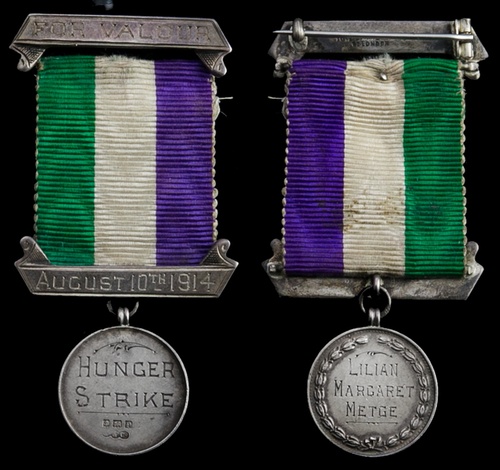
Together, the hunger strike medal awarded to suffragette Lillian Margaret Metge and the 1924 photograph of Ramsay MacDonald’s first Labour Cabinet illustrate two interconnected moments of political transformation in early twentieth-century Britain. Metge’s medal, engraved with “For Valour” and dated August 10, 1914, symbolizes the militant struggle of women who endured imprisonment and hunger strikes to force political change, highlighting that reform was often achieved through sacrifice rather than peaceful protest alone. A decade later, the photograph of MacDonald’s cabinet captures the unexpected rise of Labour to government, with its mix of working-class leaders and titled officials reflecting the social shifts made possible by earlier activist movements, including women’s suffrage. Viewed together, these objects trace a broader narrative of resistance giving way to representation, marking Britain’s transition toward a more inclusive political system shaped by both protest and parliamentary power.
Sources
The Times. “Suffragist Conspiracy Charge.” May 14, 1913.
The Daily Telegraph. “Suffragist Leaders at the Old Bailey.” June 12, 1913.
The Guardian. “Ramsay MacDonald Forms Britain’s First Labour Government – Archive, January 1924.” Edited by Richard Nelsson. January 22, 2024.
Hansard (UK Parliament). “Mr. Baldwin’s Announcement.” House of Commons Debates, January 22, 1924.
H., T. R. “Ramsay MacDonald – A Personal Sketch.” Sydney Morning Herald, January 10, 1924.
Spink. “Auction: 18002 – Orders, Decorations and Medals Lot: 478.” Accessed October 8, 2024.
Toal, Ciaran. “Rare Hunger Strike Medal Belonging to Local Suffragette Goes on Display.” Irish Linen Centre & Lisburn Museum, March 8, 2023.
Toye, Kenning and Spencer. “350 Years of History.” August 27, 2024.

Brad Johnson
Brad Johnson is a History and Modern Language Studies major from Los Angeles,
California. He specializes in political history and the German language.

Kylie Shumake
Kylie Shumake is a History and Anthropology Major and Women and Gender Studies
Minor from Weatherford, Texas.