This episode explores the impact chaplains had in the United States military throughout World War Two.
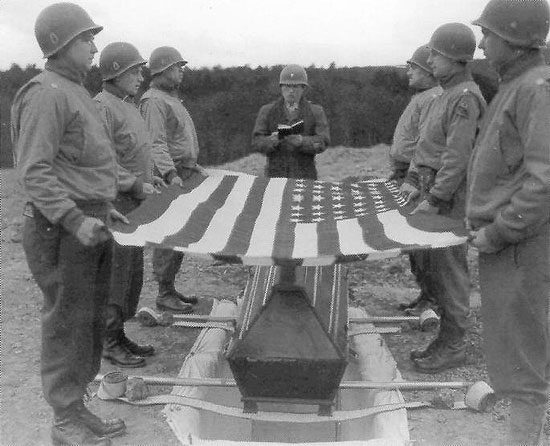
CG 3d Armored Division, Germany March 1945.
World War II US Medical Research Centre.
Sources
Cahn, Edward, Director. For God and Country. MGM for the US Army. 1943.
“Howard Daniel Morgan.” WikiTree, January 16, 2023.
Morgan, H. Daniel. “The Contribution of Texas Christian Missionary Society to Church Building in Texas from 1933-1950.” Fort Worth, TX: Brite Divinity School, 1950.
Morgan, H. Daniel. U.S. Headstone Application for Military Veterans, 1861-1985. Washington,
D. C.: National Archives and Records Administration, 1975.
“100 Kamerads Desert Goosestep for TCU Chaplain.” The Skiff, May 11, 1945.
Patton, George. Quoted in Stefanie Van Steelandt, Lady of The Army: The Life of Mrs. George S. Patton. New York, NY: Minnegate Press, 2022.
Piehler, G. Kurt. A Religious History of the American GI in World War II. Lincoln: University of Nebraska Press, 2021.
Roosevelt, Franklin D. Prayer, June 6, 1944, YouTube.
Ethel Merman, “(We’ll Be Singing Hallelujah) Marching Through Berlin,” Stage Door Canteen, Victor Records, 1942.
For Further Reading
Feldberg, Michael. “‘The Day Is Short and the Task Is Great’: Reports from Jewish Military Chaplains in Europe, 1945–1947.” American Jewish History 91, no. 3/4 (2003): 607–25.
Lee, William Sean, Christopher J. Burke, and Zonna M. Crayne. “Chaplains in Stability Operations.” Military Chaplains as Peace Builders: Embracing Indigenous Religions in Stability Operations. Maxwell Air Force Base: Air University Press, 2005.
Moss, Pamela and Michael J. Prince. Weary Warriors: Power, Knowledge, and the Invisible Wounds of Soldiers. Berghahn Books, 2019.
Snape, Michael. God and Uncle Sam: Religion and America’s Armed Forces in World War II, 47–137. Boydell & Brewer, 2015.
Virden, Jenel. “Warm Beer and Cold Canons: US Army Chaplains and Alcohol Consumption in World War II.” Journal of American Studies 48, no. 1 (2014): 79–97.
Our Expert
Dr. G. Kurt Piehler earned his undergraduate degree at Drew University and both his Master’s and Doctoral degrees in History from Rutgers University. Dr. Piehler is currently a professor at Florida State University and has authored several works including A Religious History of the American GI in World War II, which was instrumental to our research for this episode.
Anna Claire Taylor
Anna Claire derives from Shreveport, Louisiana and is currently working toward a BA in History as well as a BS in Political Science.
Sam Taylor
Sam hails from Coppell, Texas and is currently working toward a BA in History.